
There are two main coat types in Collies: the Rough Collie, which features a long, flowing double coat, and the Smooth Collie, which has a short, dense, and flat coat. Both varieties of the breed are judged under the same standard, differing only in quantity and distribution of the coat.
In terms of color, Collies typically come in four recognized varieties:
- Sable and White – ranging from light golden to deep mahogany.
- Tricolor – predominantly black with white markings and rich tan points.
- Blue Merle – a marbled blend of gray, black, and white with tan highlights.
- White – mostly white with colored markings, usually on the head and sometimes the body.
Coat Length Genetics
In most dog breeds, coat length is primarily influenced by the Fibroblast Growth Factor 5 (FGF5) gene, which plays a crucial role in regulating the hair growth cycle. The normal (functional) version of the FGF5 gene produces a protein that signals hair follicles to stop growing, resulting in short-haired coats as seen in Smooth Collies. This is the dominant form of the gene, meaning that only one copy is needed to produce short hair.
However, a mutation in the FGF5 gene disrupts this signaling process, allowing hair to grow for a longer period before shedding. This leads to longer, more profuse coats, as seen in the Rough Collie. The long-hair trait is recessive, so a dog must inherit two copies of the mutated gene—one from each parent—to express the long-haired phenotype.
Interestingly, this genetic mechanism isn’t unique to dogs. Mutations in the FGF5 gene have been observed in several other mammals, including cats, rabbits, and even humans. In humans, similar mutations can cause trichomegaly, a condition characterized by abnormally long eyelashes.
Since the gene mutation is recessive, Rough Collies can only have 2 copies of the mutant FGF5 gene. Smooth Collies, on the other hand, can either be carriers of mutant FGF5 (also known as Rough factored), or have two copies of the normal FGF5 (also known as “pure for Smooth”).
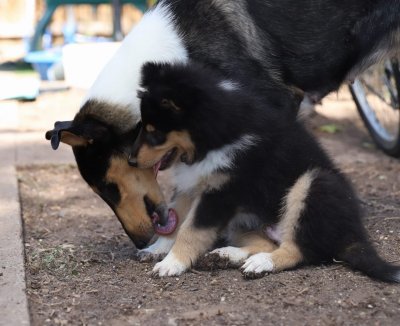
A smooth collie mom and her rough puppy
When planning a litter, Punnett squares can be created to predict the statistic distribution of coats in a litter. In these diagrams, the dominant smooth gene is indicated as an uppercase L, while the recessive rough gene is indicated as a lowercase l. The statistical distribution of each coats for that breeding are indicated as percentages.
A Punnett Square tool has been developed to help you predict the coat length outcome of Collie breedings.
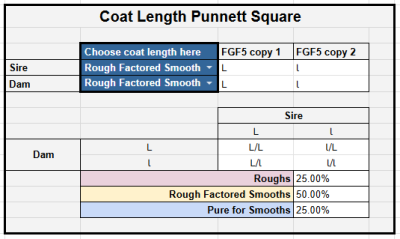
Click on the image to access the coat length tool.
Coat Color Genetics
In Collies, coat color is largely determined by the interaction of several genes, with the A (Agouti), S (White spotting), and M (Merle) loci playing key roles. These genes can come in multiple different alleles, or versions of the gene. Each dog inherits one allele from each parent.
1. A Locus (Agouti) – Base Coat Color
The A locus influences how black and red/yellow pigments are distributed in a Collie’s coat. The two most significant alleles at this locus are:
- Ay (Sable) – A dominant allele responsible for the classic sable coloration, which can range from pale gold to rich mahogany.
- at (Tan Points) – A recessive allele that, when inherited from both parents, produces the black-and-tan pattern typical of tricolor Collies, featuring black coats with tan markings and white trim.
Each dog inherits one allele from each parent, resulting in three possible combinations:
- Ay/Ay (Pure for Sable): These dogs can display a lighter sable coat and will always pass on the sable coloring to their offspring.
- Ay/at (Tricolor-Factored Sable): These dogs often have deeper sable coloring, sometimes with dark shading. They carry the gene for tricolor and can produce either sable or tricolor puppies, depending on the genetics of the mate.
- at/at (Tricolor): Dogs with this combination exhibit the classic tricolor pattern—black base coat with tan points on the face, legs, and chest, along with white markings. They can produce either sable or tricolor puppies, depending on the genetics of the mate.
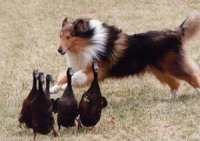
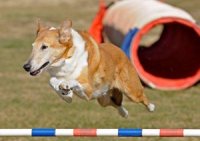
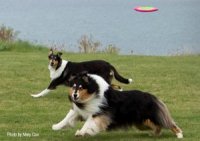
Sable and Tricolor Collies
2. S Locus (Spotting) – White Markings
The S locus controls the extent and distribution of white spotting on a dog’s coat. In Collies, this locus plays a major role in producing the breed’s signature white trim and, in some cases, nearly all-white coats.
The three primary alleles at this locus are:
- S (Solid) – Produces little to no white. This allele is rare in Collies.
- si (Irish Spotting) – The most common allele in the breed. It results in the classic white collar, chest, legs, underbelly, and tail tip seen in most Rough and Smooth Collies.
- sw (White) – Leads to extensive white coverage, often producing dogs that are mostly white with color limited to the head and sometimes small patches on the body.
When a dog inherits two copies of the White allele (sw/sw), it becomes a color-headed white Collie (CHW). These dogs have a mostly white body with a fully pigmented head—sable, tricolor, or blue merle—and may have small colored patches elsewhere. Despite their dramatic appearance, CHWs are not albino; they have normal pigmentation in the eyes, nose, and skin. Their coloration is due to extreme white spotting, not a lack of pigment production. When bred, white dogs will pass one White allele to all of their offspring.
Dogs with one copy of the White allele (si/sw) are referred to as white-factored. They may show slightly more white than typical Collies, especially on the face, legs, or tail, but often resemble standard Irish-spotted dogs. However, when bred to another dog carrying the sw allele, they can produce color-headed white offspring.

A sable-headed white Collie.
3. M Locus (Merle) – Coat Dilution Pattern
In Collies, the merle pattern is a striking coat coloration caused by a genetic mutation at the M locus, which affects how pigment is distributed in the coat. This pattern is characterized by a mottled or marbled appearance, where patches of diluted color are mixed with the base coat. The most common merle types in Collies are:
- Blue Merle – A tricolor-based coat with gray and black marbling, often with tan points and white markings.
- Sable Merle – A sable-based coat with lighter, patchy areas that can be subtle and sometimes hard to distinguish from regular sable.
Merle is a dominant trait, so a dog only needs one copy of the merle allele (M/m) to show the pattern. However, breeding two merles together (M/M) is highly discouraged due to the high risk of producing puppies with hearing and vision impairments.
The merle pattern is caused by a retrotransposon insertion in the SILV gene (also known as PMEL), which is located at the M locus. This insertion disrupts normal pigment production, leading to the diluted patches seen in merle coats.
- Non-merle (m): No insertion or a very short one; normal pigment distribution.
- Cryptic Merle (Mc): A very short insertion that may not visibly affect coat color but can still be passed on genetically.
- Atypical Merle (Ma): An short length insertion linked with a grey coat, called “maltese” in collies.
- Merle (M): A moderate-length insertion; causes the classic merle pattern.
- Harlequin Merle (Mh): A longer insertion that can result in more extreme or irregular patterns.
- Double Merle (M/M): Inheriting two merle alleles can lead to excessive white, and is often associated with serious health issues, including deafness and vision problems. Breedings that produce double merles should be avoided due to the high risks of such breedings.
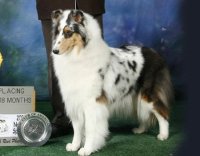

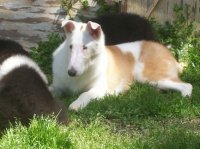
Different merle phenotypes, from left to right: a harlequin blue merle rough Collie; two blue rough puppies, one with an atypical merle color; a sable smooth double merle Collie.
The key factor in how merle is expressed lies in the length of the insertion in the SILV gene. Short insertions are considered cryptic merle, while longer insertions can lead to the higher dilution seen in harlequin merles. There is no standardized nomenclature for each length variant, which is why laboratories such as UC Davis’ Veterinary Genetics Laboratory report the length of the merle insertion, not its classification.
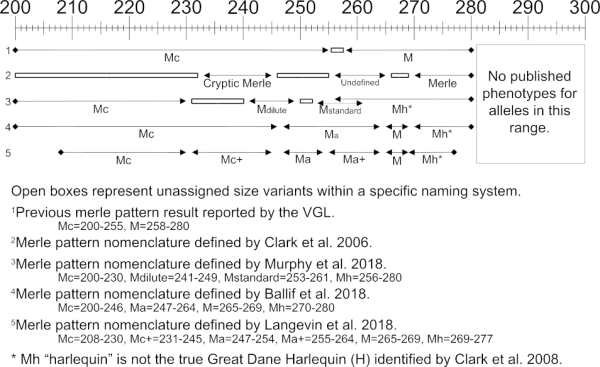
Merle Allele Nomenclature Defined by Multiple Scientific Studies. Image credit: UC Davis VGL.
The merle locus can also be affected by mosaicism. Mosaicism is a genetic phenomenon where an individual has different versions of the same gene in different cells, all originating from a single fertilized egg. This generally occurs after conception due to an error in DNA replication. Some cells will carry the exact gene inherited from the parents, while others will carry a new gene mutation.
Merle is especially affected by mosaicism, as changes in the merle insertion length occur fairly easily during cell division and gene replication. This results in a dog that may carry two different lengths of the merle gene. These individuals are not double merles: all their cells contain only one copy of the merle gene. However, the length of that copy is different in some cells. When bred, these dogs can produce offspring with either merle gene length.
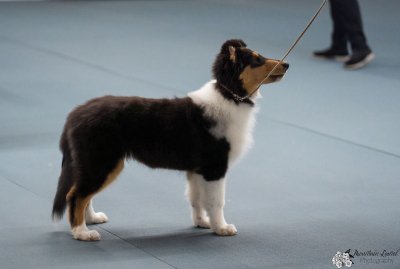
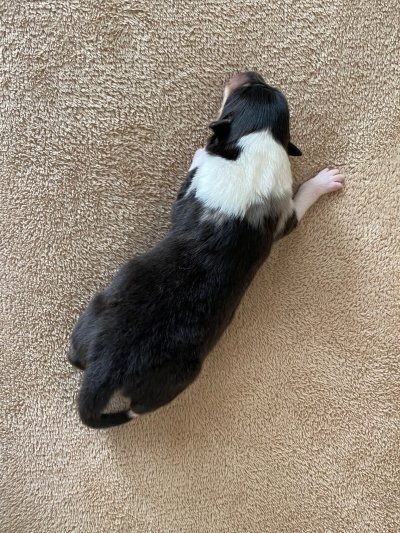
This puppy shows blue patches on its shoulder and face. DNA testing for merle showed a mosaicism of two different merle lengths: M218 (cryptic merle) and M267 (merle). The most prominent length was M218, while M267 was only present in 10% of cells. This explains why this dog is primarily tricolor with only a few patches of merle. Image credit: Marianne Sullivan.
A Punnett square tool has been developed to help predict the coat color outcome of Collie breedings.
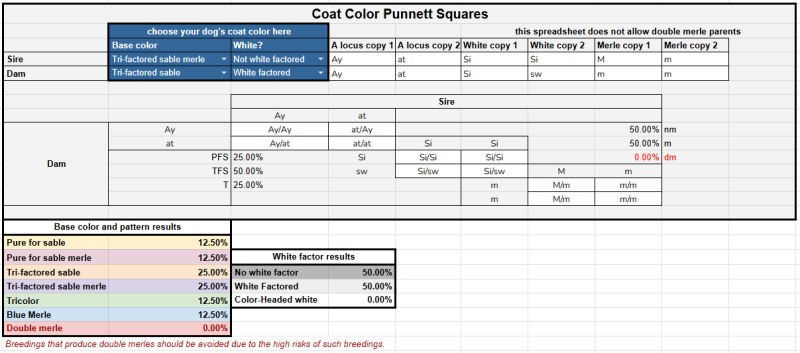
Click on the image to access the coat color tool.

